Optimizing Offshore Oil & Gas Operations with Reliable Connectivity
Solution Partner: Aegex Technologies & World Communication Network Company
Industry: Offshore Oil & Gas
The Challenge
Offshore oil and gas operations demand constant, secure, and real-time communication between offshore crews and onshore teams to maintain safety, operational efficiency, and regulatory compliance.
However, these environments present two major constraints:
- Limited wireless connectivity in remote offshore locations
- Hazardous zones where standard electronic devices are restricted due to explosion risk
This made real-time data sharing, cloud access, and operational visibility both difficult and unreliable.
The Solution
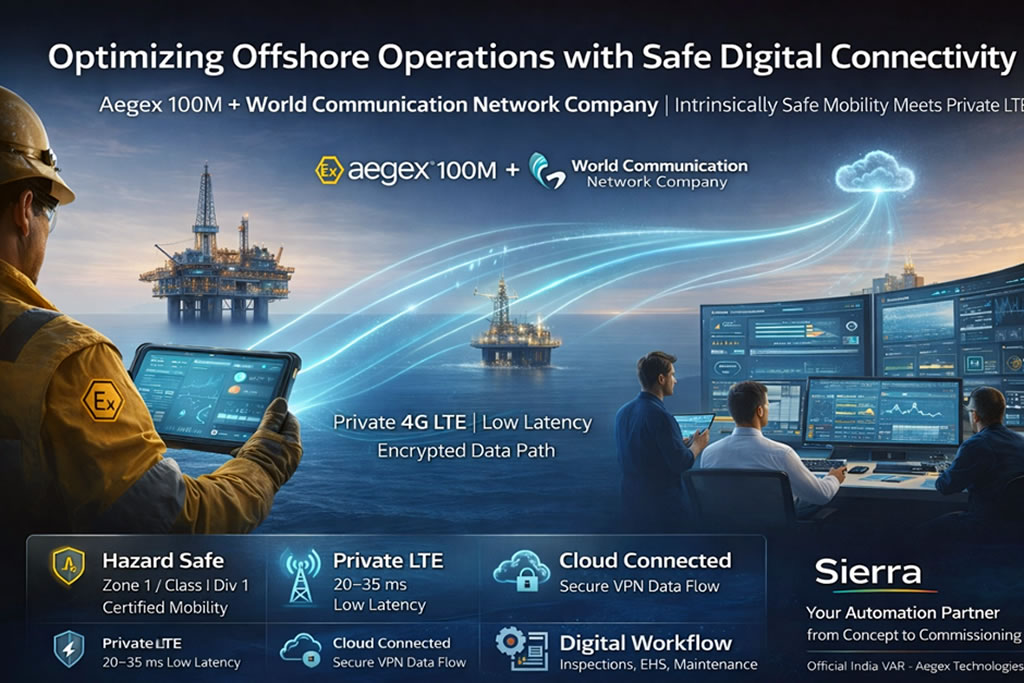
The World Communication Network Company’s high-capacity, low-latency 4G LTE offshore network was integrated with the Aegex 100M Intrinsically Safe Tablet, enabling safe, secure, and cloud-connected mobility in hazardous environments.
This combined solution allows offshore personnel to:
- Connect securely to cloud systems
- Communicate in real time with onshore teams
- Collect, manage, and share operational data directly from hazardous zones
How It Does This (Technical Workflow)
- Hazard-Zone Certified Mobility
Offshore personnel use the Aegex 100M Intrinsically Safe Tablet, certified for Zone 1 / Class I Division 1 environments, allowing safe digital operations directly inside hazardous areas without violating explosion safety regulations. - Private LTE Network Access
The tablet connects to the World Communication Network Company’s offshore 4G LTE infrastructure, which provides a dedicated, high-availability wireless link across platforms, FPSOs, and drilling rigs. - Low-Latency Data Transmission
Optimized LTE routing and offshore base stations minimize round-trip delay (20–35 ms), enabling near real-time transmission of operational data, video, work orders, and safety reports. - Secure Cloud Integration
Encrypted VPN tunnels and private LTE network segmentation securely route data from offshore devices to onshore servers and cloud platforms for SCADA, CMMS, EHS, and enterprise systems. - Real-Time Collaboration
Engineers and managers onshore receive live updates, dashboards, and alerts, allowing immediate feedback, remote troubleshooting, and decision-making without waiting for manual reporting cycles. - Digital Workflow Enablement
Inspection forms, maintenance checklists, permit-to-work systems, and incident reports are completed digitally in the field and synchronized automatically with central systems.
Technology Overview
World Communication Network Company – 4G LTE Network
- Offshore high-capacity, low-latency communication infrastructure
- Supports platforms, FPSOs, and drilling rigs
- Private LTE and VPN-based secure network architecture
- Typical latency: 20–35 ms
Key Network Capabilities:
- Bandwidth fleet sharing
- Symmetrical, guaranteed bandwidth up to 50–60 Mbps
- Unlimited upload/download
- Virtual private LTE networks per client or application
- High-reliability, low-latency connectivity
Aegex 100M Intrinsically Safe Tablet
- Zone 1 / Class I Div 1 certified for hazardous locations
- Windows 11 IoT for industrial and enterprise applications
- Secure device management and cloud connectivity
- Industrial-grade rugged design for offshore environments
The Results
The combined Aegex and World Communication Network Company solution delivered measurable improvements in offshore operations:
- Reliable real-time communication between offshore and onshore teams
- Accurate, low-cost operations monitoring
- Improved operational awareness for risk mitigation and failure prevention
- Enhanced safety, productivity, and decision-making across offshore assets
Business Impact
By enabling intrinsically safe digital mobility over a private, low-latency LTE offshore network, operators achieved continuous operational visibility, faster response times, reduced downtime, and improved regulatory compliance — even in the most remote and hazardous offshore environments.